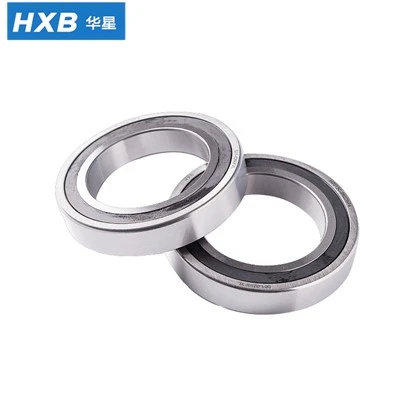
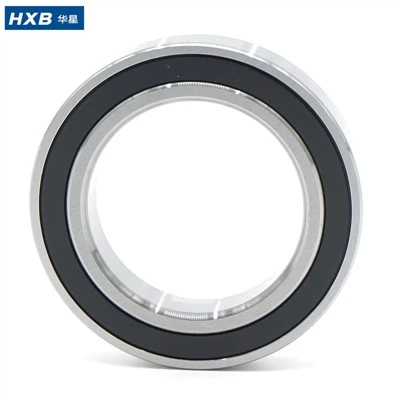
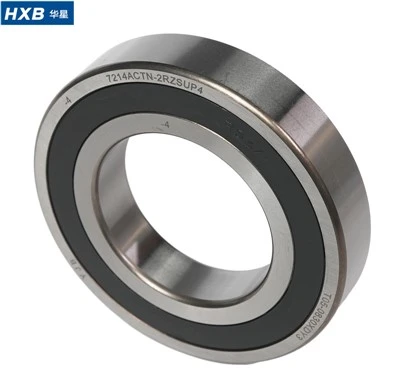
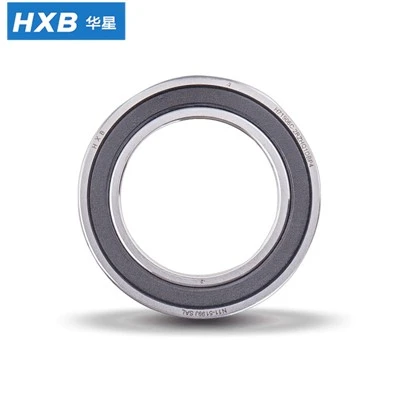
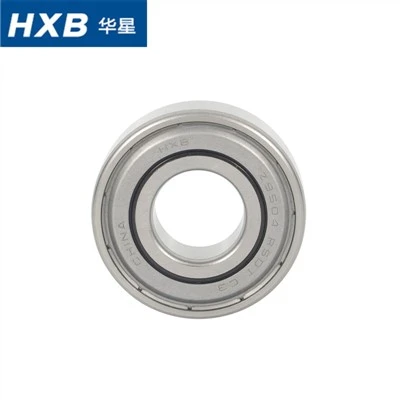
Angular contact ball bearings come in several types: 7000C (α=15°), 7000AC (α=25°), and 7000B (α=40°). These bearings feature a shoulder on the outer ring; generally, the inner and outer rings cannot be separated. They can accommodate combined radial and axial loads, as well as axial loads acting in a single direction. Axial load-carrying capacity is determined by the contact angle; the larger the contact angle, the higher the capacity. These bearings can limit the axial displacement of the shaft or housing in one direction.
Angular contact ball bearings have high limiting speeds and can simultaneously support radial and axial loads, or pure axial loads. Their axial load capacity is determined by the contact angle and increases as the contact angle increases.
Single-row angular contact ball bearings
Single-row angular contact ball bearings can only support axial loads in one direction. When subjected to radial loads, they generate an induced axial force, requiring a corresponding counter-load; therefore, these bearings are typically used in pairs. Double-row angular contact ball bearings can support heavy combined radial and axial loads (predominantly radial) acting in both directions, as well as moment loads. They limit the axial displacement of the shaft or housing in both directions and feature a contact angle of 30 degrees.
Bearing code: 7
Paired angular contact ball bearings
Paired angular contact ball bearings can support combined radial and axial loads (predominantly radial) acting in both directions, as well as pure radial loads. A tandem arrangement can only support axial loads in a single direction, whereas the other two configurations can support axial loads in either direction. These bearings are typically matched and supplied as a pair by the manufacturer; upon installation, they feature a preload interference fit, placing the rings and balls under an axial preload, thereby enhancing the rigidity and rotational accuracy of the bearing set as a single support unit.
In a back-to-back configuration (suffix DB, e.g., 70000/DB), the load lines of the paired bearings diverge away from the bearing axis. They can accommodate axial loads acting in both directions, though the load in each direction is borne by only one bearing. Bearings mounted back-to-back provide a relatively high-rigidity arrangement and can accommodate tilting moments.
In the face-to-face configuration (designated by the suffix DF, e.g., 70000/DF), the load lines of the paired bearings converge towards the bearing axis. They can accommodate axial loads acting in both directions, though the load in each direction is borne by only one bearing. This configuration is less rigid than the back-to-back arrangement and is less suitable for accommodating tilting moments; it offers lower rigidity and tilting moment capacity compared to the DB configuration.
In the tandem configuration (designated by the suffix DT, e.g., 70000/DT), the load lines are parallel, and radial and axial loads are shared equally among the bearings. However, the bearing set can only accommodate axial loads acting in one direction. If an axial load acts in the opposite direction, or if there is a combined load, a third bearing adjusted relative to the tandem pair must be added. This configuration allows for three or more bearings to be arranged in tandem at a single support position, but it can still only accommodate axial loads in one direction. Typically, to balance and limit the axial displacement of the shaft, a bearing capable of accommodating axial loads in the opposite direction is required at the other support position.
Bearing designation: 0
Load-carrying capacity (summary)
The following information applies specifically to the load-carrying capacity of paired bearings; the basic load ratings and fatigue load limits listed in the product tables apply only to individual bearings. * Basic dynamic load rating for standard bearings in any configuration and SKF Explorer bearings in back-to-back or face-to-face configurations
C = 1.62 × C (single bearing)
* Basic dynamic load rating for SKF Explorer bearings in tandem configuration
C = 2 × C (single bearing)
* Basic static load rating
C₀ = 2 × C₀ (single bearing)
* Fatigue load limit
Pᵤ = 2 × Pᵤ (single bearing)
Structural Variants
Double-row angular contact ball bearings are characterized by their ability to accommodate combined radial and axial loads and to limit axial displacement of the shaft in both directions. Compared to double-direction thrust ball bearings, these bearings offer higher limiting speeds, a 32-degree contact angle, high rigidity, and the ability to withstand significant tilting moments; they are widely used in passenger car front wheel hubs (some models use double-row tapered roller bearings of the same dimensions).
There are four structural variants of double-row angular contact ball bearings:
Type A: Standard design for bearings with an outside diameter ≤ 90 mm. No filling slots; capable of accommodating equal axial loads in both directions. Features a lightweight glass fiber-reinforced nylon 66 cage, resulting in minimal temperature rise during operation.
Type A: Standard design for bearings with an outside diameter > 90 mm. Features a filling slot on one side and is equipped with either a pressed steel cage or a machined brass cage.
Type E: An enhanced design featuring a filling slot on one side, allowing for a greater number of balls and thus higher load-carrying capacity.
Shielded and sealed variants: Both Type A and Type E double-row angular contact ball bearings are available with shields (non-contact) or seals (contact) on both sides. Sealed bearings are pre-filled with anti-rust lithium-based grease and typically operate within a temperature range of -30°C to 110°C. They require no relubrication during service and should not be heated prior to installation. When installing double-row angular contact ball bearings, care must be taken; although the bearings can accommodate axial loads in both directions, if a filling slot is present on one side, the primary axial load should not be directed against the raceway shoulder on the side with the slot.