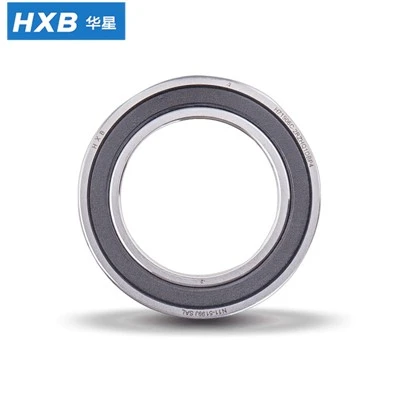
Selecting the contact angle for angular contact ball bearings is a critical decision that directly impacts bearing performance and application effectiveness.
The following are detailed considerations and recommendations:
1. Ratio of Axial Load to Radial Load
- High Axial Load: If axial load dominates the application, a larger contact angle (e.g., 40°) should be selected, as this provides higher axial load-carrying capacity.
- High Radial Load: If radial load is more significant, a smaller contact angle (e.g., 15°) is more suitable, as it offers better radial load-carrying capacity.
2. Load-Carrying Capacity Requirements
- Heavy-Load Applications: In applications requiring support for heavy loads, selecting a larger contact angle can increase the bearing's load-carrying capacity and service life.
- Light-Load Applications: For light or moderate loads, a smaller contact angle may be chosen to reduce costs and improve efficiency.
3. Rotational Speed Requirements
- High-Speed Operation: At high speeds, a smaller contact angle helps reduce friction and heat generation, thereby enhancing the bearing's speed capability and service life.
- Low-Speed Operation: In low-speed or static applications, the choice of contact angle has less impact, though a larger contact angle generally provides better axial stability.
4. Rigidity and Stability
- High Rigidity Requirements: A larger contact angle provides higher axial rigidity, making it suitable for applications requiring high precision and stability.
- Low Rigidity Requirements: If the application does not demand high rigidity, a smaller contact angle can be selected to achieve greater flexibility.
5. Application Scenarios
- Machine Tool Spindles: These typically require high axial rigidity and load-carrying capacity; therefore, a larger contact angle (e.g., 30° or 40°) is selected.
- Electric Motors and Generators: These devices often involve high-speed operation and may require a smaller contact angle (e.g., 15°) to minimize friction and heat.