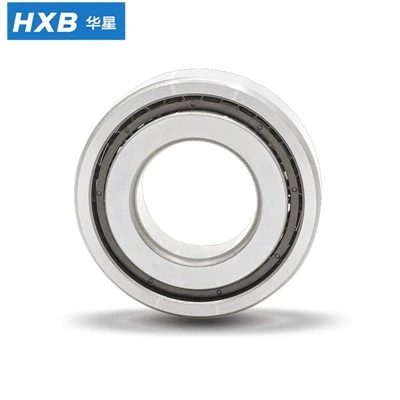
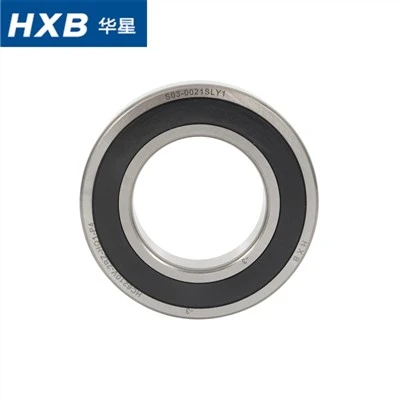
When it comes to the selection between single - row and double - row ball screw support bearings, it's a decision that can significantly impact the performance and efficiency of your machinery. As a trusted supplier of ball screw support bearings, I'm here to walk you through the key factors that should guide your choice.
Understanding Single - Row and Double - Row Ball Screw Support Bearings
Single - row ball screw support bearings consist of a single row of balls. They are designed to handle simple radial and axial loads. Due to their simple structure, they are generally more compact and lightweight. This makes them a great choice for applications where space and weight are critical factors. For example, in some small - scale automated equipment, the limited installation space requires a bearing that can provide sufficient support without taking up too much room. A single - row bearing like the Ball Screw Support Bearing 7602030TVP is well - suited for such applications. It offers reliable performance in a relatively small package.
On the other hand, double - row ball screw support bearings have two rows of balls. This design allows them to handle higher radial and axial loads compared to single - row bearings. They also have better stiffness and can maintain higher precision under heavy loads. Double - row bearings are often used in applications where the machinery needs to operate with high accuracy and stability, such as in large - scale machine tools. The Ball Screw Support Bearings 7603020TVPDBP4 is an excellent example of a double - row bearing that can meet the demanding requirements of heavy - duty applications.
Factors to Consider When Selecting Bearings
Load Requirements
The first and most crucial factor is the load that the bearing will be subjected to. If your application involves light to moderate loads, a single - row ball screw support bearing may be sufficient. These bearings can handle the normal radial and axial forces exerted during normal operation. For instance, in a 3D printer, the movement of the print head requires relatively low - load support. A single - row bearing can provide the necessary stability without over - engineering the system.
However, if your machinery experiences high - magnitude radial and axial loads, a double - row bearing is the better option. In industrial milling machines, for example, the cutting process generates significant forces. A double - row bearing can withstand these forces without compromising the accuracy of the machine's movement. This is because the two rows of balls distribute the load more evenly, reducing stress on individual components.
Precision and Rigidity
Precision is another key consideration. In applications where high precision is required, such as in semiconductor manufacturing equipment, the bearing's ability to maintain accurate positioning is critical. Double - row ball screw support bearings generally offer higher precision due to their better load - distribution characteristics. They can also provide greater rigidity, which helps to minimize deflection under load.
The Angular Contact Thrust Ball Bearing 15TAC47B is a type of bearing that combines angular contact design with thrust capabilities, offering high precision and rigidity. It is often used in applications where precise axial positioning is essential.
Speed Requirements
The operating speed of your machinery also plays a role in bearing selection. Single - row bearings typically have a lower rotational inertia, which allows them to achieve higher speeds more easily. They are suitable for applications where high - speed operation is required, such as in some high - speed spindle systems.
Double - row bearings, while capable of handling high loads and providing high precision, may have slightly higher rotational inertia due to their larger mass. However, modern double - row bearings are designed to minimize this effect and can still operate at relatively high speeds. For example, the Angular Contact Thrust Ball Bearing 30TAC62BDGG is engineered to provide a good balance between load - carrying capacity, precision, and speed.
Installation Space
As mentioned earlier, installation space is an important consideration. If your equipment has limited space, a single - row ball screw support bearing is often the more practical choice. Its compact design allows it to fit into tight spaces without sacrificing performance.
Conversely, if space is not a constraint and you need the extra load - carrying capacity and precision of a double - row bearing, then you can opt for a larger - sized double - row bearing. The Ball Screw Support Bearings BS17M47P4AUM is a well - designed double - row bearing that can be installed in applications where there is sufficient space to accommodate its size.
Real - World Examples of Bearing Selection
Let's take a look at some real - world scenarios to further illustrate the selection process.
CNC Lathe
A CNC lathe is a machine tool that requires high precision and the ability to handle significant cutting forces. In a typical CNC lathe, the ball screw support bearings are responsible for transmitting the motion from the motor to the cutting tool. Due to the high loads and the need for precise positioning, double - row ball screw support bearings are commonly used. The double - row design ensures that the bearings can withstand the radial and axial forces generated during the turning process, while maintaining high precision.
Linear Actuator
A linear actuator is a device that converts rotational motion into linear motion. In some small - to - medium - sized linear actuators, single - row ball screw support bearings are sufficient. These actuators are often used in applications such as automated doors, robotic arms in small - scale assembly lines, etc. The single - row bearings provide the necessary support for the relatively low - load and high - speed operation of these actuators.
Cost Considerations
Cost is always a factor in any engineering decision. Generally, single - row ball screw support bearings are less expensive than double - row bearings. This is because they have a simpler design and fewer components. If your application does not require the high load - carrying capacity and precision of a double - row bearing, choosing a single - row bearing can result in significant cost savings.
However, it's important to consider the long - term cost as well. A lower - cost single - row bearing may need to be replaced more frequently if it is used in an application where it is subjected to excessive loads. On the other hand, a more expensive double - row bearing may provide better performance and longer service life, which can result in lower overall costs in the long run.
Contact for Professional Advice and Purchase
Selecting the right ball screw support bearing is a complex decision that requires a comprehensive understanding of your application's requirements. As an experienced supplier of ball screw support bearings, we have the expertise and product range to help you make the best choice. Whether you need a single - row bearing for a light - load application or a double - row bearing for a heavy - duty machine, we can provide you with high - quality products and professional advice.
If you are interested in learning more about our ball screw support bearings or have any questions regarding bearing selection, please feel free to contact us. We are ready to assist you in finding the most suitable bearings for your specific needs. Our team of experts will work closely with you to understand your requirements and provide you with customized solutions.


References
- Harris, T. A., & Kotzalas, M. N. (2007). Rolling Bearing Analysis. John Wiley & Sons.
- Eschmann, P., Hasbargen, H., & Weigand, E. (1985). Ball and Roller Bearings: Design, Application, and Analysis. John Wiley & Sons.